
Tendon To It: Latest In Tendinopathy Rehabilitation
After years of casual gym workouts, Jason decided to take his strength training more seriously, until something went wrong.
Over six weeks, he progressively increased volume and intensity, adding overhead presses, pull-ups, and heavier bench work.
Around week five, he began feeling a dull ache after sessions at the front of his shoulder —especially with pressing movements or reaching overhead. It would settle by the next day, so he kept training.
By week seven, the ache became more persistent, affecting sleep and everyday tasks like putting on a shirt. Despite his gradual build-up, Jason had overloaded his rotator cuff, leading to a reactive tendon flare-up. (Reactive Tendinopathy)
This article will break down exactly what happened to Jason and why. It will map out a realistic road to recovery, including the phases of tendon recovery and how to deal with the treacherous setbacks.
Tendons – What Are They
Tendons are dense connective tissue that connect muscles to bones. They store and release energy and help our muscles transmit forces across our joints.
Tendons are made up of individual fibres running parallel to each other like a cable or rope. They act much like a spring in that they can uncoil under load and spring back to create force.
Phases Of Tendinopathy
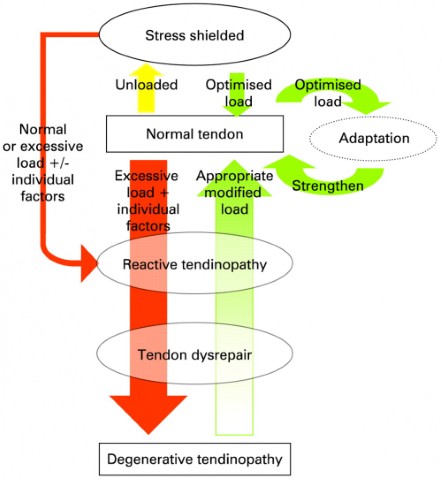
Reactive Tendinopathy
Normally, a tendon gets stronger over time if there is more load placed on it. Usually this doesn’t make a tendon thicker, although in the short term it can to make the tendon stronger. This is the bodies response to reduce the overall stress to the tendon. (Cook, 2009)
In this stage, the tendon has the potential to revert to normal if the load on the tendon is sufficiently reduced or if there is enough time between loading sessions.
Degenerative Tendinopathy
If a reactive tendon is pushed continually through an overload pattern it will result in a gradual change in the makeup of the cells that make up the tendon. At the Degenerative Tendinopathy stage it becomes significantly more difficult to reverse and rehab will mostly consist of volume/loading modification rather than true tendon healing.
This can also happen when a tendon is unloaded, as the tendon cells also change in a similar pattern to an overloaded state and the mechanical integrity of the tendon is also reduced.
Rehabilitation Of The Acute Tendinopathy
Phase 1: Rebuild the Base – Tolerating Load Again (Week 2-4)
One of the main goals is to reduce pain. Its important to find what loads the tendon can tolerate so that it can begin to adapt.
The aim is to find the right recipe of exercise to begin loading without increasing pain. This will consist holding or slowly lowering exercises. These slower exercises allow the tendons to load all of the fibres more thoroughly and increasing collagen production (Docking, 2013).
There is also usually a place for manual therapy and taping to continue to help settle down painful tissues. Quick movements like jumping or throwing is avoided in this stage as they create lots more force in the tendon. Let’s lay a strong, resilient foundation to build on for the rest of the rehab journey.
This phase can take 2-4 weeks and will likely be working alongside the other phases.
Phase 2: Building Strength and Capacity (Week 4-8+)
Here we aim for gradual loading, aiming towards loads heavier than body weight for the lower limb. This continues to train your tendon to manage other tasks.
For reference, the knee needs to withstand up to 5 times your body weight during running (Hart, 2022). This means that we need to add resistance gradually to keep strengthening the tendon.
The faster you move through an exercise, the more force will be required (Force = Mass x Acceleration) so as you improve, the speed of each movement will also be increased. We commonly prescribe 3-5 sets of 6-10 reps of each exercise during this phase. Strengthening takes time, so consistency is key!
Phase 3: Return to Full Function / Maintenance (Weeks 8+)
This phase won’t be for everyone, but will be important if your goals include returning to sport or running.
We’re expecting very minimal pain in this stage increasing confidence in your movement and function. The highest tendon loads are reserved for this stage – sprinting, cutting, skipping, throwing, hitting, Olympic lifting, kipping. All the real sporty stuff.
If you don’t have any of these goals, this phase will be about getting a plan to keep you strong and resilient for anything life throws at you!
Setbacks, Flare-Ups, and the Mental Game
Don’t be discouraged by flare- ups. In trying to find what loads the tendon can handle, it’s very likely that there will be times of increased pain or irritation.
The flare-up is feedback, not failure.
That information will be very useful in choosing the right exercises and will be a useful measure to compare to for gauging recovery in the future. And don’t worry – you won’t lose your strength gains in a few days of having to ease off (Issurin V., 2008).
Go back to what you were doing in Phase 1-2 for a few days to a week. Also think about external factors like sleep, nutrition, or stress that might be contributing to the flare-up.
Summary: The Tendon Recovery Roadmap
Week 0-2: Flare up → Settle symptoms, deload and develop a plan of attack
Week 2-4: Phase 1 → Introduce gentle strengthening exercise and begin loading tendon
Week 4-8: Phase 2→ Build strength and capacity
Week 8+: Phase 3→ Return to function and sport and maintenance program
Don’t go it alone, get a trained physiotherapist to guide you, encourage you, train you and test you along the way. For best results expect to be seen 2x per week for Phase 1 and 1x-2x for Phase 2, and then every 1-2 weeks for Phase 3.
Written by: Reuben Vanderduys